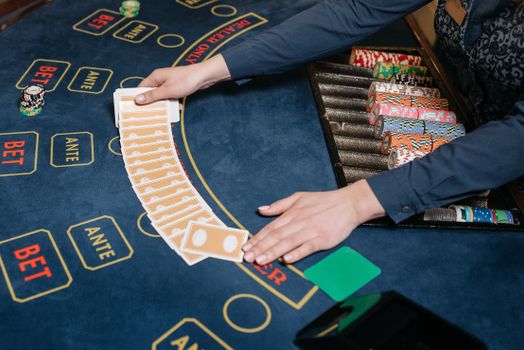
Casino games have long captured the public’s imagination, combining the excitement of chance with the allure of big winnings. But beneath the flashing lights and spinning wheels lies a world governed not by luck alone, but by the immutable laws of mathematics. From the probability-driven design of card games to the statistical edge built into every slot machine, mathematical principles are the silent orchestrators of every casino experience. Understanding these principles not only demystifies how casinos operate but also empowers players to make more informed decisions at the gaming tables.
The Role of Probability in Casino Game Design
At the heart of every casino game is probability—the mathematical measure of how likely an event is to occur. Whether it’s predicting the next card in blackjack or the outcome of a roulette spin, probability shapes every aspect of the gaming experience.
For example, consider a simple coin toss: the probability of getting heads is 1 in 2, or 50%. Most casino games, however, are designed so that the odds are slightly tipped in favor of the house. In American roulette, the wheel contains 38 slots (1-36, 0, and 00). The probability of the ball landing on any single number is 1 in 38, or about 2.63%. Yet, the payout for a single-number bet is 35 to 1—less than the true odds—ensuring the casino retains a mathematical advantage.
.png)
In blackjack, the probability of drawing certain cards changes as the deck is dealt, giving rise to strategies like card counting. For instance, the probability of being dealt a blackjack (an Ace and a 10-value card) in a single-deck game is about 4.8%. Understanding these odds allows savvy players to make decisions that maximize their chances of winning, although the house edge is never fully eliminated.
House Edge: The Casino’s Mathematical Advantage
One of the most important mathematical concepts in casino gaming is the house edge. This refers to the average percentage of each bet that the casino expects to keep over the long run. The house edge is meticulously calculated for each game to ensure profitability for the casino while still offering players the chance to win.
Take European roulette as an example. The wheel contains 37 slots (1-36 and a single 0). If you bet on a single number, the chance of winning is 1 in 37 (approximately 2.70%), but the payout is 35 to 1. The expected return for this bet is therefore (1/37) x 36 = 0.973, or 97.3%. This means the house retains a 2.7% edge.
Slot machines are another area where the house edge is carefully engineered. The return to player (RTP) percentage typically ranges from 85% to 98%, meaning the house edge can vary from 2% to 15%. For example, if a slot machine has a 95% RTP, the house edge is 5%—for every $100 wagered, the casino expects to keep $5 on average.
Randomness and the Law of Large Numbers
Casino games are driven by random events—card shuffles, dice rolls, or the spin of a wheel. To ensure fairness and unpredictability, casinos use sophisticated random number generators (RNGs), especially in digital games and slot machines. These RNGs are rigorously tested to ensure that no pattern or bias can be detected, upholding the principle of randomness.
The law of large numbers, a fundamental theorem in probability, explains why casino games are reliable sources of profit for operators in the long run. This law states that as the number of trials increases, the actual results will converge to the expected probabilities. For example, while a player might experience a streak of wins or losses in the short term, over thousands or millions of bets, the outcomes will align closely with the calculated house edge.
This is why casinos thrive over time, even if individual players occasionally hit large jackpots. The mathematical certainty of large numbers ensures the house always wins in the aggregate.
Comparing House Edges: Popular Casino Games
Not all casino games are created equal when it comes to odds. The house edge varies widely depending on the game and the rules in play. Understanding these differences is vital for players seeking the best chance of winning—or at least minimizing losses.
| Casino Game | Typical House Edge | Best Strategy House Edge | Notable Fact |
|---|---|---|---|
| Blackjack | 1.5% – 2% | 0.5% (with basic strategy) | One of the lowest house edges when played optimally |
| European Roulette | 2.7% | 2.7% | Single zero wheel, better odds than American version |
| American Roulette | 5.26% | 5.26% | Double zero increases house edge |
| Baccarat (Banker bet) | 1.06% | 1.06% | Lowest house edge for a major table game |
| Craps (Pass Line bet) | 1.41% | 1.41% | Adding odds bets can reduce effective house edge |
| Slot Machines | 2% – 15% | Varies by machine | Edge built into payout programming |
As this table shows, games like baccarat and blackjack (with perfect play) offer the lowest house edges, while slots and American roulette can carry much higher built-in disadvantages for the player.
Expected Value and Payouts: Calculating Long-Term Outcomes
Another key mathematical principle in casino gaming is expected value (EV). This represents the average amount a player can expect to win or lose per bet over the long term. EV is calculated by multiplying each possible outcome by its probability and summing the results.
Consider a simple wager on a single number in European roulette:
- Probability of winning: 1/37 - Payout: 35 to 1 (win $35 for every $1 bet) - Probability of losing: 36/37 - Loss: -$1The expected value (EV) per $1 bet: EV = (1/37 x $35) + (36/37 x -$1) = $0.946 - $0.973 = -$0.027
This negative EV means that, on average, the player loses about 2.7 cents per dollar wagered—mirroring the house edge.
Slot machines also use expected value in their design. For instance, if a slot has an RTP of 96%, the EV per $1 bet is -$0.04, indicating a 4% house edge. These calculations guide both casino profitability and responsible gaming practices.
Variance, Volatility, and Game Selection
While house edge and expected value describe the average outcome, variance and volatility explain the swings in winnings and losses that players experience. Variance measures how widely results can differ from the average, while volatility refers to the degree of risk or fluctuation in a game’s payouts.
Slot machines are typically high-variance games: they offer the chance of large jackpots but also long stretches of small or no wins. Table games like baccarat or blackjack are lower variance, providing more consistent, albeit smaller, returns.
This distinction matters for players with different goals. High-variance games may appeal to thrill-seekers hoping for a big win in a short session, while low-variance games suit those seeking longer, steadier play with smaller swings in fortune.
Mathematics and Casino Game Innovation
The mathematical foundations of casino games also drive innovation in the industry. Game designers use probability theory, statistics, and computer simulations to create new games that are both fair and engaging. For example, modern video slots employ complex algorithms to ensure random outcomes while maintaining a desired house edge.
Casinos also use mathematical modeling to set promotional offers, loyalty rewards, and even to detect unusual betting patterns that may indicate cheating or advantage play. In the age of online casinos, big data and machine learning are increasingly used to personalize gaming experiences while ensuring regulatory compliance.
Moreover, regulators employ mathematicians and statisticians to audit casino games, guaranteeing that the odds and payouts are transparent and fair for players.
Understanding the Math: Empowering Players and Promoting Fair Play
The mathematical principles behind casino games are not just tools for casinos to ensure profitability—they are essential for maintaining trust, fairness, and entertainment value. For players, understanding the basics of probability, house edge, and expected value can transform the gaming experience from a pure gamble to a more informed and strategic activity.
Informed players can choose games with the best odds, manage their bankrolls more effectively, and avoid the pitfalls of chasing losses. Meanwhile, casinos continue to rely on mathematics to design games, set payouts, and ensure long-term sustainability.
Ultimately, the interplay of chance and mathematics is what makes casino gaming both thrilling and reliably profitable for operators. Whether you’re spinning a slot reel or playing a hand of blackjack, the invisible hand of mathematics is always at play.